Growth
How to Get New Catering Buyers in 2026 (Without Buying Lists)
Almost every catering operator gets the same offer in their inbox: "We have 50,000 verified office manager emails in your city." The list is junk, the conversion is near zero, and you burn your sender reputation in the process.
There are six channels that actually generate qualified catering buyers in 2026, ranked by realistic ROI for an operator starting from zero. This post walks through each one.
Why are bought lists worse than ever?
Three changes since 2020:
- Email providers have gotten ruthless. Send to a cold list of 5,000 and you trigger spam filters across Google and Microsoft within hours. Your sender domain is now suspect for everything.
- Compliance is real. CCPA, GDPR if you have any EU traffic, and a growing pile of state-level laws. Unsolicited B2B email is enforceable in more places every year.
- The decision-makers have learned. Office managers see 20 catering pitches a week. They delete them all.
This does not mean cold outreach is dead. It means you have to do it with intent data, not lists.
What channels actually generate B2B catering buyers?
In order of ROI for a starting operator:
1. Referrals from existing happy customers
The single highest-ROI channel in catering. A referred buyer converts at 30 to 50 percent vs 2 to 5 percent cold. Lifetime value is 2 to 3 times higher.
The lever: actively ask. After a successful event, in the 2-hour follow-up window, ask one specific question: "Do you know one other office manager who hosts events like this?" Not "refer us if you know anyone." One specific person.
Incentive: $200 to $500 Amazon gift card on a closed referral. The math: a $500 incentive on a $30K-LTV customer is 1.7 percent CAC. You will not beat this anywhere else.
2. LinkedIn intent-based outreach
Not mass connection requests. Searches in Sales Navigator for trigger events: new office manager hires, recent posts about events, companies that just funded.
Reach out personalized to the trigger. Reply rate: 12 to 20 percent. Conversion to demo: 25 to 35 percent. Full playbook.
3. Local SEO + Google Business Profile
A properly optimized Google Business Profile (photos, reviews, hours, service area, posts) generates 5 to 30 free leads per month for most catering operators in mid-size cities. Free is the keyword.
The lever: ask every happy customer for a Google review during the 2-hour follow-up. The number of reviews compounds your local ranking.
4. Catering-specific marketplaces (carefully)
ezCater, Hangry, similar. Yes the commissions are painful. As acquisition channels they still work. The key is treating them as top-of-funnel only and migrating customers to direct over time.
5. Office building partnerships
Class A and B office buildings in business districts often have a "preferred vendor" list. Getting on it requires a relationship with property management. One building of 1,000 employees yields more catering volume than 100 cold emails.
High effort to land, very high return once landed.
6. Community sponsorships (in your delivery zone)
Local chambers of commerce, business networking groups, charity events. Sponsor a breakfast for the local chapter of SHRM (Society for Human Resources Management). 80 HR directors in one room. Free food breaks the ice.
Lower ROI per dollar than channels 1 to 3, but builds local awareness that compounds.
Where should you start with a small budget?
With zero to $1,000/month:
- Channel 1 (referrals): free, $500 budget per closed referral.
- Channel 3 (Google Business Profile): free, requires only time.
- Channel 6 (one sponsorship): $200 to $500 for one breakfast event.
That is enough to generate 10 to 30 qualified conversations per month in most US metros.
What is the conversion math at each channel?
Approximate, calibrate to your zone:
| Channel | Cost per lead | Conversion to demo | Conversion to customer | |---|---|---|---| | Referral | $0 (until close) | 50% | 30 to 50% | | LinkedIn intent | $5 to $15 | 15 to 25% | 25 to 35% | | Google Business Profile | $0 | 8 to 15% | 20 to 30% | | Marketplace | $50 to $150 | n/a (order is the conversion) | 35 to 55% repeat | | Office partnership | $500 to $2,000 setup | 30 to 50% | 60% | | Community sponsorship | $200 to $500 per event | 10 to 20% | 25% |
What channels should you ignore?
Four channels that work for other industries but rarely return for catering operators of your size:
- Cold email blasts to bought lists. Already covered. Skip.
- Facebook/Instagram ads for B2B catering. B2B buyers are not researching catering on Instagram. (B2C events are different.)
- Generic SEO content marketing. Writing 50 blog posts before you have a customer is putting the cart before the horse. Get customers first, then write to extend reach. (This post exists because we have customers.)
- Cold-calling without intent data. A trained SDR cold-calling without trigger context will book one meeting per 80 dials. The math does not work.
Key takeaways
- Referrals from existing happy customers are the highest-ROI catering channel by far.
- Use the 2-hour follow-up window to ask for referrals while satisfaction is at peak.
- LinkedIn intent-based outreach (trigger events) is the strongest cold channel.
- Free channels (referrals + Google Business Profile) generate enough volume to start. Paid channels accelerate.
- Skip bought lists, B2B Instagram ads, and generic content marketing until you have a customer base to leverage.
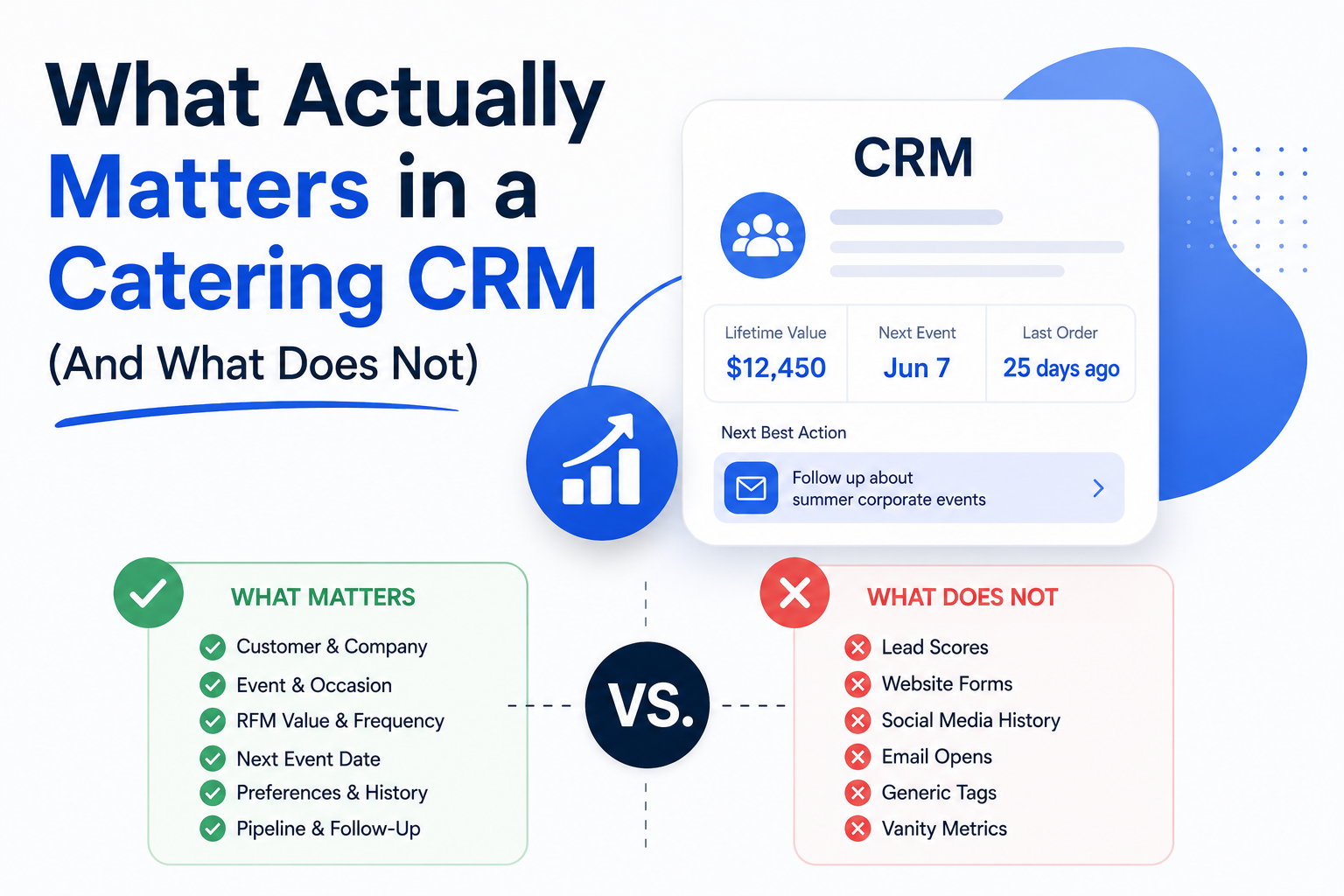
If you want a CRM that actually tracks referral source, conversion path, and lifetime value of each acquisition channel, request a demo.