B2B
Why Amazon Gift Cards Win More B2B Catering Customers Than Discounts
If you have ever tried to land a corporate catering account by offering 10 percent off, you already know the problem: nothing happens. The buyer thanks you, files the email, and forgets you exist.
But send the same buyer a $50 Amazon gift card to schedule a demo or place a first trial order, and suddenly your meeting calendar fills up.
The difference is not the dollar amount. A 10 percent discount on a $500 order is also $50. The difference is who gets the value, and what behavioral lever it pulls. This post walks through why, when to use gift cards in catering acquisition, and how to do it without legal trouble.
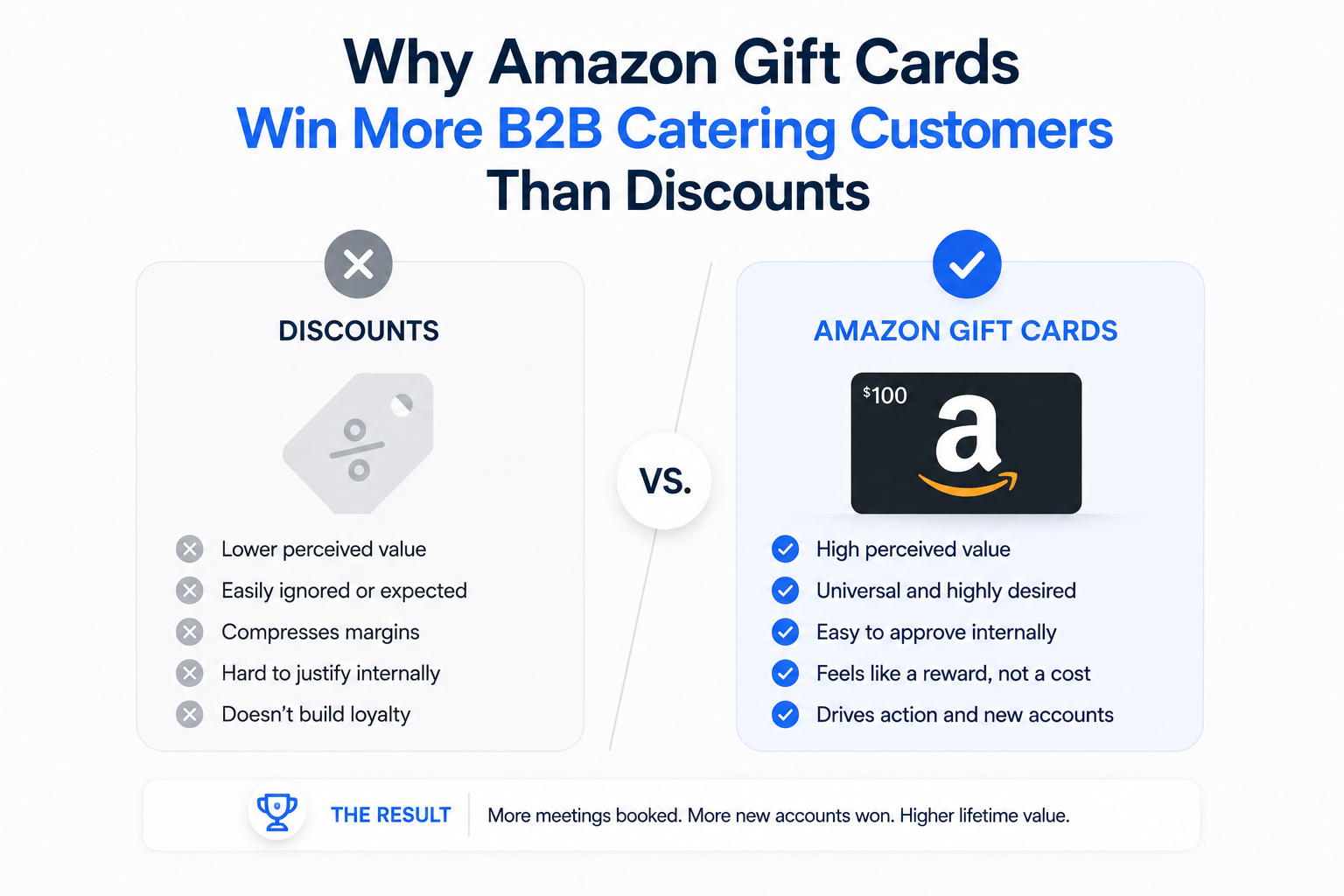
Why do discounts fail against B2B catering buyers?
Three reasons, all rooted in how corporate buyers actually behave.
The person evaluating you is not the person paying
In a B2B catering deal, the office manager or executive assistant is choosing the caterer. The company is paying. A 10 percent discount goes to the company. The person making the decision gets nothing personal out of it.
This is the single biggest reason discount offers underperform in B2B catering. The misalignment of incentive is structural.
Discounts trigger procurement scrutiny
A discounted price becomes the new baseline. Procurement teams will ask why you can drop 10 percent and whether the original price was inflated. The discount becomes a liability instead of an incentive.
Discounts are forgotten the moment they expire
A buyer who used a discount once does not become a loyal customer. They become someone shopping for the next discount.
What makes a gift card work where a discount does not?
A gift card flips all three dynamics.
The value goes to the person, not the company
The office manager keeps the $50 Amazon card. The company pays the same as it would have paid anyone else. The decision maker now has a personal reason to remember your name.
This is not a bribe. The Amazon card is positioned as a thank-you for the time taken to evaluate, not as a quid pro quo for placing an order. (Stay on that side of the line.)
Amazon is a brand the buyer already trusts
A $50 Starbucks card, Target card, or your-brand-coupon card all introduce some friction. Amazon does not. Everyone uses Amazon. There is zero hesitation about whether the value is real.
The offer is memorable
A buyer who got a discounted catering order forgets about you in 2 weeks. A buyer who got a $50 Amazon card from you remembers the gesture for months. Memorable beats cheap in B2B.
How big should the gift card offer be?
A few rules of thumb from operators who run these offers consistently.
- Demo or discovery call: $25 to $50. The job is just to get the meeting.
- First trial order: $75 to $150. The job is to push past the inertia of switching caterers.
- Referral of a new corporate account: $200 to $500. Strong incentive without crossing into compliance trouble.
- Win-back of a lapsed major account: $250 to $500. Bigger card for accounts that historically spent $5K+ per quarter.
Do the math against the lifetime value of the account. A corporate buyer ordering $2,000 per month for 24 months is $48,000 in revenue. A $100 gift card to acquire that is a 0.2 percent CAC. You will lose much more on every discount you ran.
When should you use it and when not?
Use it when:
- Acquiring net new B2B accounts that are evaluating multiple caterers
- Winning back a lapsed major account that has gone quiet
- Generating qualified meetings with companies of 50+ employees
- Sourcing referrals from happy existing accounts
Do not use it when:
- Acquiring B2C individual customers (no incentive alignment problem to solve)
- Public sector or government accounts (gift policies vary, easy to cross a line)
- Healthcare or legal industry contacts (industry-specific compliance rules)
- Small dollar transactions where the gift card is more than 10 percent of the order value (math gets ugly)
How do you stay inside Amazon's rules?
Amazon gift cards are a great tool, and Amazon does not love them being used as promotional bribes for unrelated services. Three guidelines keep you safe.
- Buy cards through Amazon's Corporate Gift Card program for any volume above $500 per month. The program is designed for exactly this kind of use.
- Frame the card as a thank-you for time, not as payment for an outcome. Words matter: "thanks for taking the meeting" works. "$50 if you order today" does not.
- Send digital codes via email, not physical cards. Cleaner audit trail, faster delivery, no shipping cost.
And check with your accountant: in most jurisdictions a gift card given as a marketing expense is fully deductible, but the rules vary.
Key takeaways
- Discounts fail in B2B catering because the decision maker does not pocket the savings.
- Gift cards work because they reward the person evaluating you, not the company paying.
- $25 to $50 buys a demo. $75 to $150 buys a trial order. $200 to $500 buys a referral or a win-back.
- Use Amazon's Corporate Gift Card program for compliance and audit cleanliness.
- Frame as a thank-you for time, never as payment for an outcome.
If you want to see how AIA's CRM tracks the corporate buyers most likely to convert on a gift card offer, walk through the CRM or request a demo.