CRM
What Actually Matters in a Catering CRM (And What Does Not)
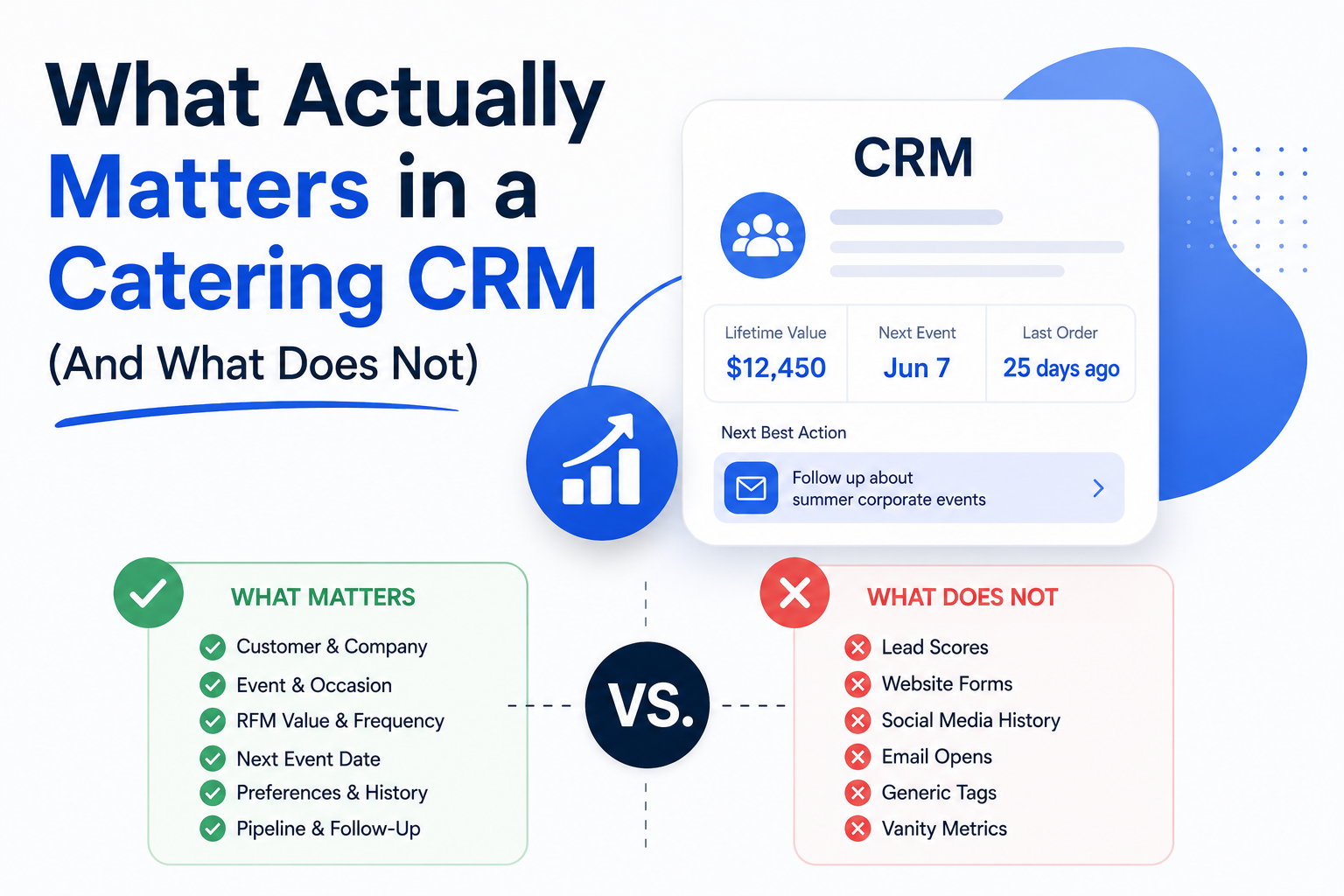
Most CRMs sold to restaurants are repackaged B2B sales tools. They have lead stages, deal pipelines, and email cadences built for software sales reps. They miss almost everything a catering operator actually needs.
A catering CRM has a different shape. The center is not a deal, it is a customer profile that updates with every order. The metrics are not stage conversion, they are recency, frequency, and average order value. The actions are not move-to-next-stage, they are reorder, cross-sell, or reactivate.
This post lays out what a catering CRM should actually do, what fields matter, and which standard CRM features are mostly noise.
Why are generic CRMs the wrong shape for catering?
A classic CRM is built around a sales funnel: lead, qualified, proposal, closed, lost. Each customer moves through stages, then exits.
In catering, customers do not exit. A corporate buyer who ordered last month should order next month. A wedding planner who placed one big order should refer two more. The funnel mental model breaks because the highest-value motion is repeat, not close.
What a catering operator needs is a customer 360, not a pipeline. The center is the customer, and around them sit: orders, dietary, channels, ratings, loyalty, and follow-up history. Stages do not appear anywhere.
What fields actually matter in a catering CRM?
Nine fields do almost all the work. If a CRM nails these, it earns its keep.
Contact basics
- Name, primary phone, alternate phone, email
- Multiple saved delivery addresses (B2B buyers ship to several offices)
- Preferred channel (the one they actually answer on)
Behavior
- Total orders
- Lifetime spend
- Average order value (AOV)
- Last order date and days inactive
- Average guests per order
Preferences
- Top items they order, with quantities and revenue per item
- Dietary restrictions: allergies, intolerances, religious, lifestyle
- Preferred day and time window
Loyalty
- Current points balance
- Tier (if any)
- Full ledger of points earned, redeemed, expired
Notice what is missing: deal stage, lead score, sales rep owner. Skip them. They do not move catering revenue.
What signals predict the next sale?
Three signals do most of the predictive work.
Recency
The single best predictor of the next order is the last one. A B2B customer ordering every 2 weeks who is now at week 4 is at risk. A B2C customer ordering quarterly who is at month 5 is gone unless you reach out.
Most operators only realize this in hindsight. A CRM that flags the inactivity gap proactively turns it into revenue.
Frequency drift
A customer used to order monthly. Now it has been 9 weeks. The frequency drift is the early warning sign for churn. Catch it at week 6, reactivate. Catch it at month 4, you are usually too late.
Channel switch
A customer who always replied on WhatsApp suddenly went silent. Or a customer who only emailed started texting. Either signals a change. The first usually means they moved or switched jobs. The second usually means they are placing a more urgent order than usual.
These three signals (Recency, Frequency, and Channel) plus Monetary Value give you classical RFM analysis. RFM is the most leveraged report in any catering CRM.
How should a CRM handle B2B versus B2C?
These are fundamentally different objects.
B2C (individuals)
The customer is the person. One profile, one buying pattern, simple.
B2B (companies)
The customer is the company, not the person. A single corporate account might have 4 authorized buyers, all ordering for the same office. Orders should consolidate at the company level, but each person stays trackable.
Most CRMs only have a Contact object, not a Company object. They cannot represent B2B catering cleanly. You end up with 4 contacts that share an address and no way to see the company total.
AIA's CRM has both. Customers and Companies are separate first-class objects, and orders roll up at the company level automatically.
What can you skip?
Everything else, almost. Specifically:
- Lead scoring: customers come from orders, not lead funnels.
- Deal stages and pipelines: a catering order is not a 6-month deal.
- Sales rep ownership: orders come in across channels, no single owner.
- Email cadences for cold outreach: warm follow-up is where the money is.
- Forecasting modules built for SaaS revenue: irrelevant.
If your CRM has these, ignore them. If your CRM only has these and is missing the 9 fields above, get a different CRM.
Key takeaways
- A catering CRM is a customer 360, not a sales pipeline.
- Nine fields do most of the work: contact, addresses, channel preference, order behavior, preferences, dietary, loyalty.
- The three highest-leverage signals are recency, frequency, and channel switch.
- B2B catering requires a Company object separate from Contact. Most CRMs do not have one.
- Skip lead scoring, deal stages, and sales rep ownership. They are noise.
If you want to see a CRM that is actually shaped for catering, walk through AIA CRM or request a demo.