Follow-up
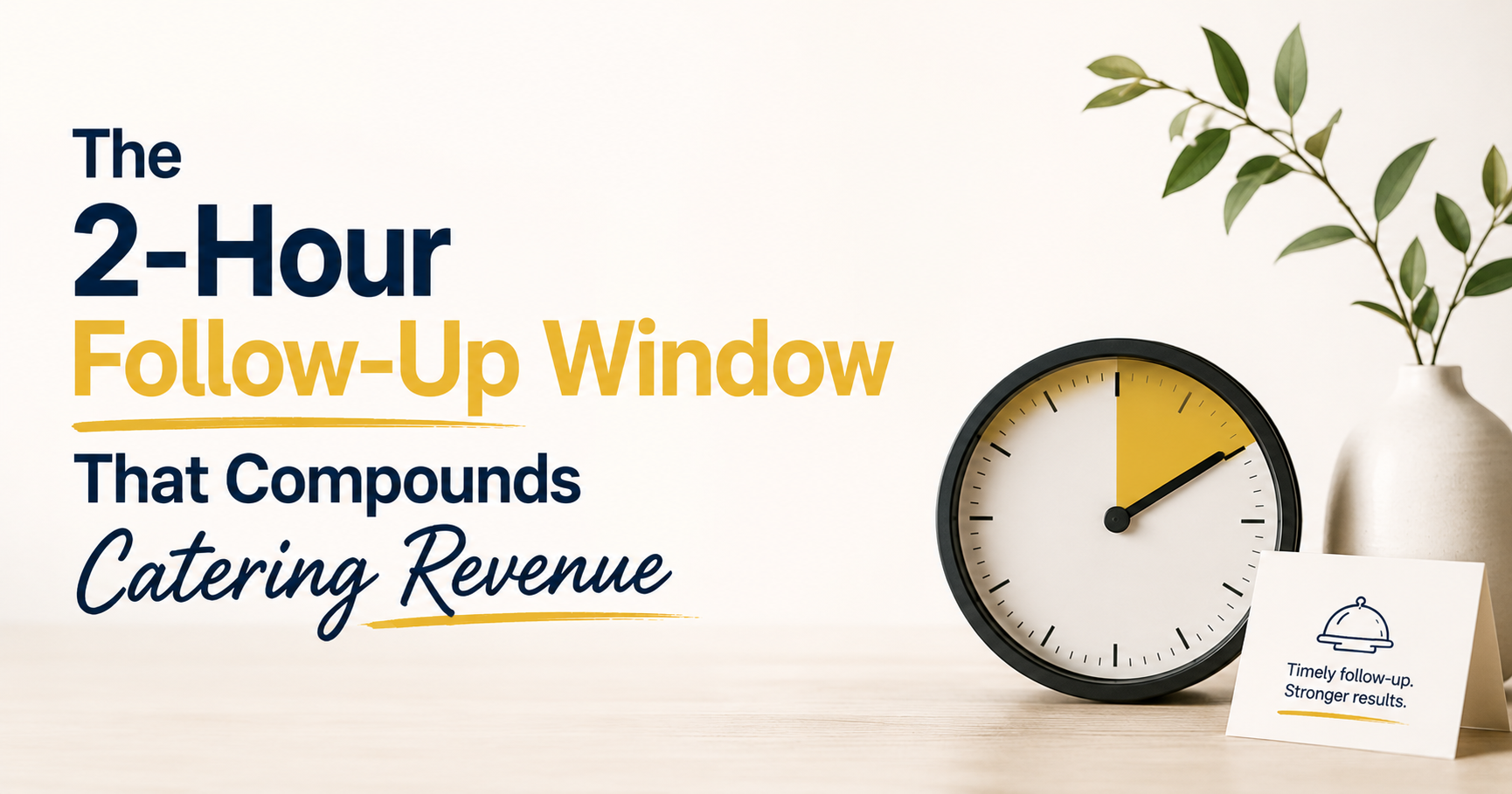
The 2-Hour Follow-Up Window That Compounds Catering Revenue
Most catering operators think follow-up is a thank-you. It is not. Follow-up is a sale.
If you message a customer within 2 hours of their catering being delivered, while they are still digesting the food and watching their team finish it, your repeat order rate roughly doubles. Wait 24 hours and the same customer responds at half the rate. Wait a week and the moment is gone.
This post explains why timing matters this much, what a high-leverage follow-up actually says, and how to run this across hundreds of orders per month without a person doing it by hand.
Why does timing matter this much?
Three behavioral reasons.
Peak satisfaction
The office is happy. The lunch is on the table. Compliments are flying. The buyer's positive emotion is at a 90-day high. This is the only window where they will say yes to almost anything: a reorder, a referral, a review.
Wait 48 hours and the emotion has decayed back to baseline. Wait a week and they have moved on to next week's lunch problem.
Email saturation
In 24 hours your follow-up will be buried under 200+ other emails. In 2 hours it is the top of the inbox while the buyer is still actively looking at their phone for compliments.
Mental availability
Cognitive psychology calls this "recency salience." The brain weights recent events more heavily for future decisions. Reach the buyer while you are still on their mind and you remain the default.
What does a 2-hour follow-up actually contain?
Not "thanks for ordering." Specifically:
A check-in (1 line)
"Hi Maria, hope today's lunch landed well at the team meeting." Names the order, names them, signals you remember.
A request for input (1 sentence)
"Anything that did not go as planned, just tell me directly." Opens the channel for complaints before they go to a review site.
A specific reorder offer (1 sentence)
"Want me to put the same menu on the calendar for next Tuesday at 11:30am?" Specific. Concrete. Easy to say yes.
Three sentences. No marketing copy. No discount code. Just direct conversation.
Which channel should you use?
Use the channel they ordered on. If they placed the order by WhatsApp, follow up on WhatsApp. Email, then email. Text, then text.
This sounds obvious. Most operators violate it constantly by sending a templated email to every customer regardless of channel preference. The result is a 4 to 6 percent reply rate. Following up on the channel they actually answer on hits 25 to 40 percent.
If you do not know which channel a customer prefers, the CRM should tell you. If you do not have a CRM tracking it, that is the first thing to fix.
How do you automate it without sounding robotic?
This is the part most operators get wrong. Automation reads as automation. Customers can smell a templated message in two words.
Three rules to keep automated follow-up human.
1. Pull specific order details into the message
Not "thanks for your order." Use the actual menu item, the actual headcount, the actual location. "Hope the 25 Mediterranean platters landed on time at the Coral Gables office."
2. Vary the opening line
Three to five rotating openings. Never the same phrase twice in a row for the same customer.
3. Have AI score the reply and route it
A positive reply ("loved it, book us again") goes to a reorder offer. A neutral reply ("food was good, delivery late") routes to a human. A negative reply ("order was wrong") routes to a manager immediately and suppresses that customer from upcoming marketing.
AIA's follow-up flow does all of this automatically. Without it, you need a system the operator manually maintains, which most operators never sustain.
What metrics should you track?
Four numbers, weekly.
- Follow-up reply rate. Target: 25 percent or higher. If you are at 5 percent, the message is wrong, not the timing.
- Reorder rate from follow-up. Target: 8 to 15 percent of customers who replied. Higher is great, lower means the reorder offer is generic.
- Sentiment distribution. Target: 70 percent positive, 20 percent neutral, 10 percent negative. If positive is below 50, something operational is broken (probably delivery or food quality).
- Time from delivery to follow-up. Target: under 2 hours, 90 percent of the time. This is the input that drives all three of the above.
If you only track one, track the last one. It is the leading indicator.
Key takeaways
- The 2-hour window is the single highest-leverage action in catering retention.
- Wait 24 hours and reply rates drop ~50 percent. Wait a week and you have lost the moment.
- A good follow-up has three lines: check-in, ask for feedback, specific reorder offer.
- Use the channel they ordered on. Never send a generic email if they used WhatsApp.
- Automate with AI sentiment scoring so positive replies route to reorder, negative replies route to recovery.
If you want this follow-up loop running on every order automatically, walk through AIA or request a demo.