SEO/GEO
GEO vs SEO: How AI Search Is Already Changing Catering
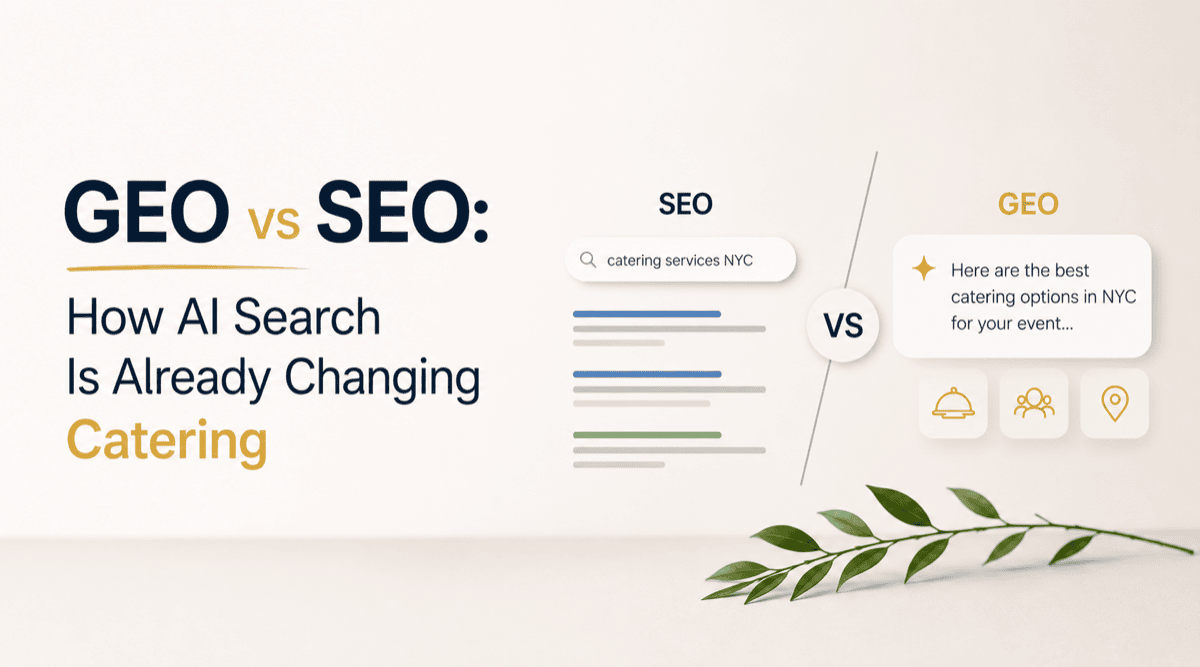
Two years ago, a corporate buyer looking for catering opened Google, typed "best corporate catering Miami," and clicked the top result. In 2026 that same buyer increasingly opens ChatGPT or Perplexity and asks: "Recommend a corporate catering company in Miami that does Latin food and handles 25 to 50 people for office lunches."
The difference matters. Google returns a ranked list of links. AI engines return a single synthesized answer with a few sources cited. If your business is not cited, you are not just below the fold. You are invisible.
This post covers what GEO is, what AI engines weigh, and what catering operators should do to be the cited source.
What is GEO and how is it different from SEO?
SEO (Search Engine Optimization) is optimizing your site to rank in a list of links on Google or Bing.
GEO (Generative Engine Optimization) is optimizing your site to be cited by AI engines like ChatGPT, Perplexity, Google AI Overviews, Claude, and Microsoft Copilot.
Some tactics overlap (clean structure, good titles, fast pages). But the emphasis shifts:
- SEO rewards keyword targeting and backlinks. GEO rewards direct, factual, quotable content.
- SEO success means ranking #1. GEO success means being the source the AI quotes.
- SEO uses sitemap.xml. GEO adds llms.txt.
- SEO loves long-form articles. GEO loves clear Q&A and statistics.
Are buyers really using ChatGPT to find caterers?
Yes, and the share is growing fast.
Industry research firms tracking AI search adoption in late 2025 and early 2026 report:
- 30 to 40 percent of high-intent B2B buyers now use an AI engine as a first step before Google.
- For services with complex requirements (catering qualifies: dietary restrictions, headcount, delivery zone), AI usage is even higher.
- Conversion from an AI citation is materially better than from a Google ad click, because the user arrives pre-qualified by the AI's recommendation.
This is not a future-state argument. The shift is happening now.
What signals do AI engines weigh that Google does not?
Five things AI engines reward that Google does not particularly care about.
1. Direct factual claims with citations
"Pincho processed $1.2M in catering revenue across 11 stores with one manager." That sentence is quotable. AI engines pick those up and cite them.
2. FAQ structure with explicit answers
Google has supported FAQ schema for years but does not strongly prioritize it. AI engines prioritize it heavily. A page with 10 FAQ questions and direct answers gets cited far more often than a page with the same information buried in prose.
3. llms.txt
A dedicated text file (similar to robots.txt) that summarizes your business for LLM ingestion. Google ignores it. ChatGPT, Claude, Perplexity, and Anthropic crawlers explicitly look for it.
4. Conversational headings
H2 headings phrased as questions ("How does AIA capture orders?") match the conversational queries users type into AI engines. Topic headings ("Order Capture") do not.
5. Bilingual content
AI engines weight multilingual capability heavily. If your site has Spanish-language content for a Latin-market query, you win citations that English-only sites cannot.
What should you change on your website right now?
Three changes, in order of impact.
Add llms.txt
A plain-text manifest at /llms.txt summarizing your business in 1-2 pages. Include product names, channels, pricing model (without specific prices), key customers, geographic coverage, languages supported. AIA's llms.txt is a working example.
Add FAQPage schema to your site
At minimum on the homepage and a dedicated FAQ page. The 10 most-asked buyer questions, with direct answers. FAQPage JSON-LD on both. This single change drives more AI citations than any other on-site optimization.
Rewrite your headings as questions
Replace "Our Services," "About Us," "Why Choose Us" with the actual questions buyers ask: "What does AIA do?" "How is this different from competitors?" "How fast can we deploy?"
Will this kill SEO or replace it?
It will not kill SEO. Most users still use Google for navigational queries. But for discovery and evaluation queries, AI engines are already the first stop for a meaningful share of high-intent buyers.
The smart move is to do both. SEO basics (sitemap, fast pages, keyword-aware titles) still matter. Add the GEO layer on top.
Key takeaways
- Buyers increasingly start at AI engines instead of Google for evaluation queries.
- GEO success is measured in citations, not in rankings.
- The five biggest GEO wins: llms.txt, FAQPage schema, question-based headings, factual claims, and bilingual content.
- AI engines reward direct, quotable, structured content. They penalize marketing fluff.
- Doing both SEO and GEO is the only safe strategy. The shift is happening, but Google is not gone.
AIA's site is built with GEO in mind: full llms.txt, FAQ with schema, structured data per page, and bilingual product copy. If you want to see what an AI-native marketing surface looks like, walk the rest of askaia.ai and view-source the head.