Delivery
The Quiet Reason Your Catering Loses Money: Unreliable Delivery
Everyone in restaurant operations knows delivery is hard. Catering delivery is harder. The order is bigger, the window is tighter, the customer is a procurement officer who books 50 lunches a month, and there is no second chance.
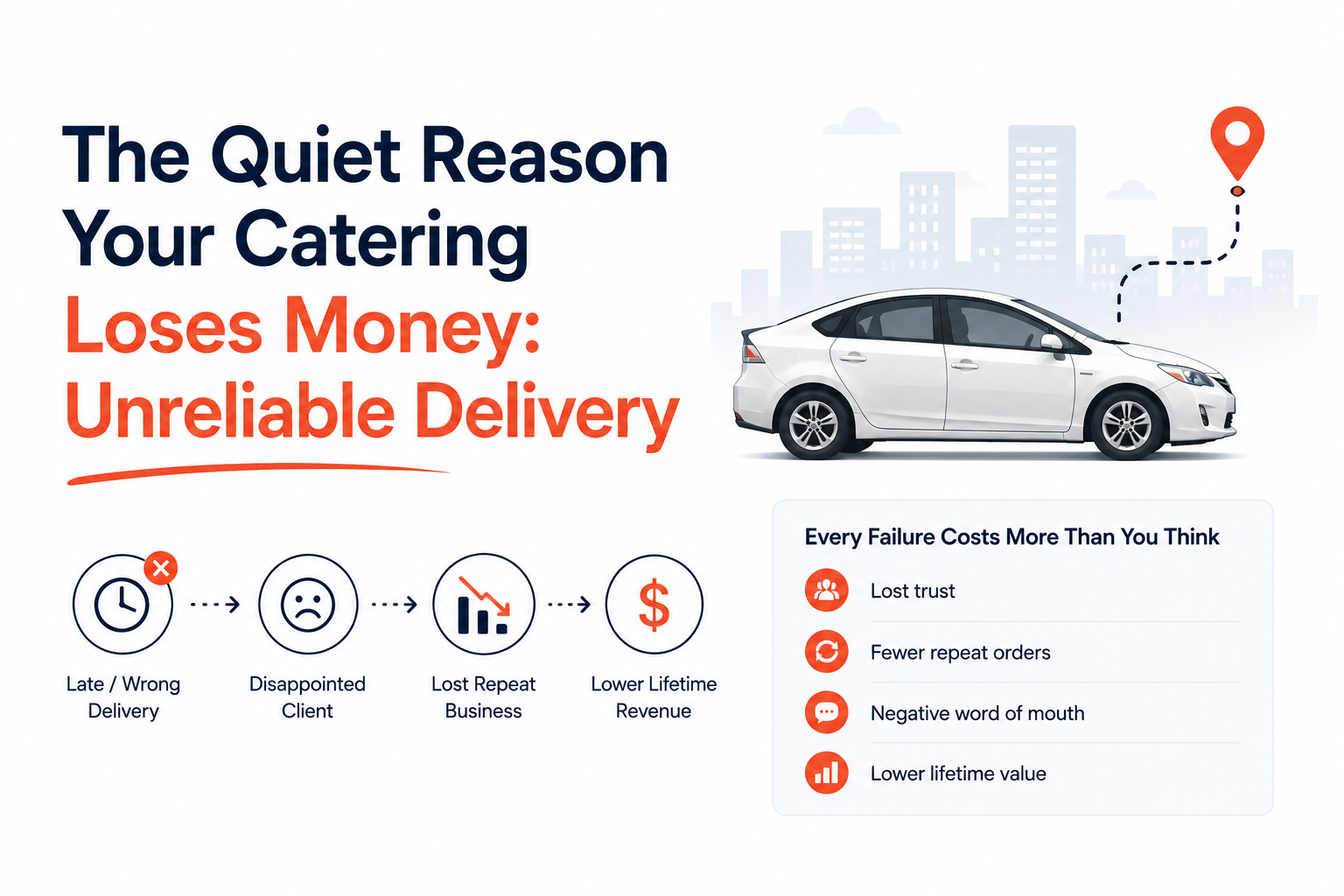
Unreliable delivery is the single most expensive failure in catering, and it is invisible on a P&L. The lost order does not show up as a loss. It shows up as a customer who quietly never books you again.
This post walks through the real cost, why catering delivery is uniquely hard, and what a reliable operation looks like in 2026 (without owning a fleet).
What does one bad catering delivery actually cost?
Let's do the math on a single late lunch.
A corporate account orders $400 of catering for Wednesday at noon. The delivery arrives at 12:35. The 25-person team is already at the meeting. They eat anyway. The office manager makes a polite note.
Direct cost: zero. You delivered the food. They paid.
Real cost:
- Lost reorders: This account ordered every 2 weeks. Annual value: ~$10,400.
- Lost referrals: Office managers talk. A typical engaged buyer refers 2 to 3 peers per year. At 50 percent close rate, that is ~$15,000.
- Negative reputation: They probably told the team you were late. 25 people now have a bad data point about your brand.
The real cost of that one late delivery is closer to $25,000 over 18 months, not $400.
Most operators never tie the lost revenue back to the delivery failure. It just shows up as accounts that quietly stop ordering.
Why is catering delivery harder than regular restaurant delivery?
Five structural reasons.
1. The window is rigid
A DoorDash order can arrive 10 minutes late and nobody notices. A catering order arriving 10 minutes late ruins a meeting. The window is real.
2. The volume is bigger
A single corporate order is 50 to 200 portions. That is multiple insulated bags, multiple setups, multiple staff at the receiving end. One missing item is a problem the customer cannot ignore.
3. The food is more fragile
Individual hot meals tolerate a 20 minute drive. A 30-tray pasta bar does not. Temperature drift, sauce migration, and presentation degradation all compound at scale.
4. The customer is institutional
Corporate buyers, school administrators, healthcare facilities. Mistakes get escalated, documented, and remembered.
5. The driver is often a stranger
Most operators hand off catering to a third-party delivery service that treats it like a normal DoorDash order. The driver does not know that the 25 boxed lunches need to go into a conference room at exactly 12:00.
What are the failure modes that hurt catering specifically?
In order of frequency, what actually goes wrong:
- Late arrival (40 to 50 percent of catering complaints)
- Cold or compromised food (20 to 30 percent)
- Missing items or wrong setup (15 to 25 percent)
- Delivery to wrong location (5 to 10 percent, but high impact when it happens)
- No setup help when promised (5 to 10 percent)
Note that the top three are all preventable with better logistics, not better food.
Do you need to own your delivery operation?
No, but you do need to control it.
There are three workable models:
Own your fleet
Works for high-volume operators with predictable delivery zones. Best reliability, biggest fixed cost. Worth it above roughly 200 catering deliveries per month per location.
Single specialist partner
Services like Cartwheel and similar specialist catering delivery companies. Built for catering specifically: driver training, insulated equipment, scheduled pickup, white-glove service. Best balance of cost and reliability for most operators.
Multi-provider with dispatch software
Use a delivery management layer that picks the best provider per order. Best for operators in multiple cities where no single partner covers everywhere. Requires a platform that can orchestrate (AIA Deliveries does this).
The wrong answer is using a generic on-demand service designed for $15 individual orders for your $400 catering drops.
What does a reliable catering delivery operation look like in 2026?
Four traits show up in every reliable operation.
- Real-time tracking visible to the customer. The office manager should see the driver on the way without having to call you.
- ETA precision under 5 minutes. Not "between 11:30 and 12:30." 11:55, plus or minus 5.
- Driver assigned and named before pickup. No surprises. The customer knows who is coming.
- Automatic recovery process when something goes wrong. A delay, a missing item, a wrong-address mistake should trigger an immediate offer (replacement, partial refund, future credit) before the customer complains.
That is what catering delivery should feel like. Most operators are still running 2015 logistics on 2026 customer expectations.
Key takeaways
- One late catering delivery costs ~$25K in lost lifetime revenue, not the order value.
- Catering delivery is structurally harder than regular delivery: rigid windows, bigger volume, fragile food, institutional customers.
- Top three failures (late, cold, missing items) are logistics problems, not food problems.
- You do not need to own a fleet. Specialist partners (like Cartwheel) or dispatch software both work.
- Real-time tracking, sub-5-minute ETA precision, named drivers, and automatic recovery are the 2026 baseline.
If you want delivery dispatched from inside your CRM with real-time tracking and multi-provider routing, walk through AIA Deliveries or request a demo.