Follow-up
Sentiment-Driven Follow-Up: Stop Selling to the Guests You Just Disappointed
Almost every catering operator running follow-up makes the same mistake. They send a generic reorder offer to every customer, including the customer who just had a cold lunch delivered 40 minutes late.
The customer who is annoyed gets a marketing message instead of an apology. The relationship breaks. The next event goes to a competitor.
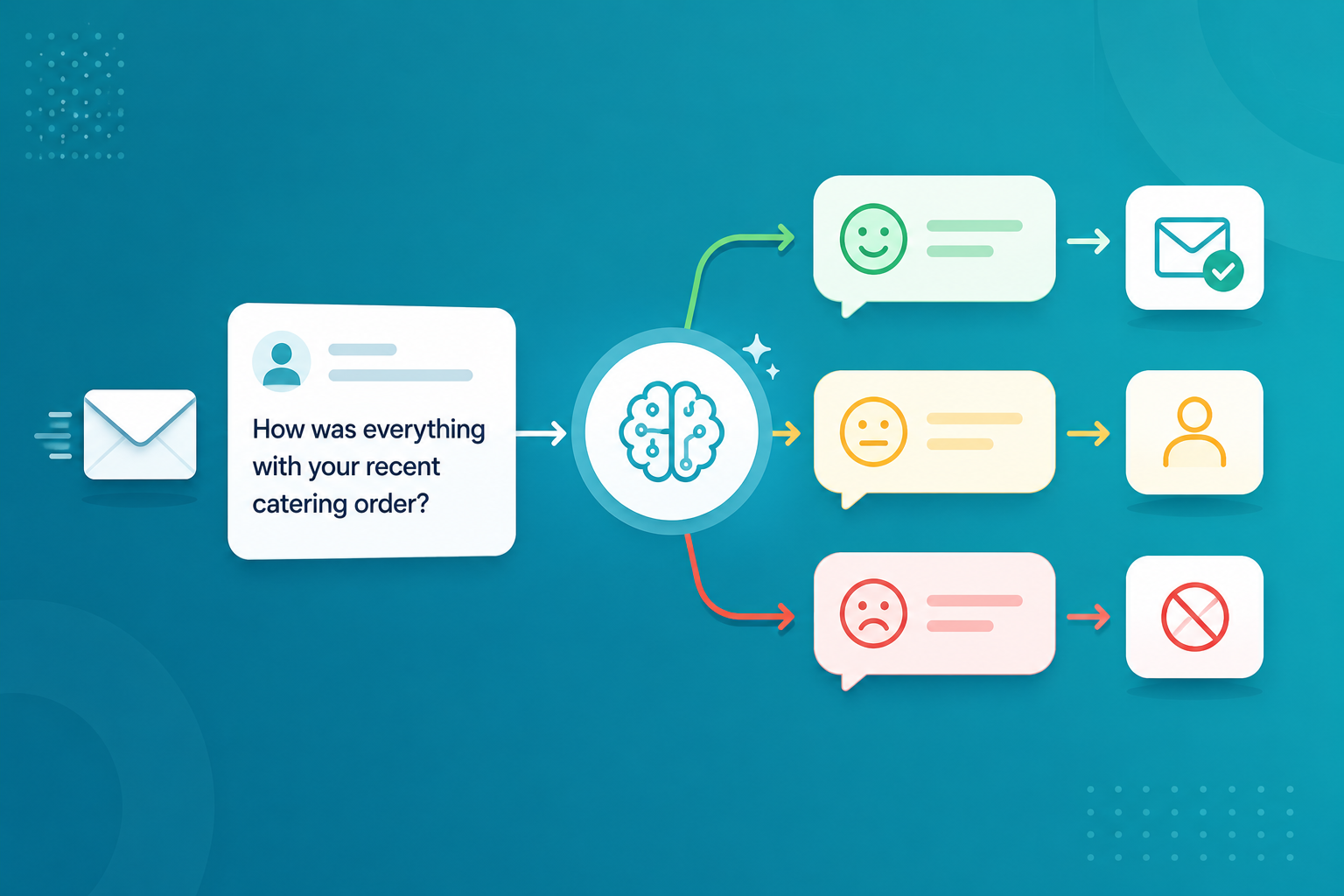
Sentiment-aware follow-up reads each reply before doing anything, scores it as positive, neutral, or negative, and routes the response accordingly. Positive replies trigger a reorder offer. Negative replies suppress all marketing and route the customer to a human. Neutral replies ask one targeted question.
This post explains the system, why it matters in catering specifically, and how accurate the sentiment scoring actually needs to be.
What is sentiment analysis in this context?
Sentiment analysis is a language model reading a customer's reply and classifying the emotional tone.
Three buckets are enough:
- Positive: "Loved it, booking again for July."
- Neutral: "Food was good, delivery was a little late."
- Negative: "Order was wrong, please do not contact me."
That is the whole science. The hard part is acting on the classification correctly.
Why does it matter for catering specifically?
Three reasons unique to catering.
The order is big and the stakes are high
A bad $15 lunch is a minor irritation. A bad $400 corporate catering order in front of 25 people is a story the office manager will tell for weeks. Recovery has to be immediate, personal, and from a human.
Most catering complaints are quiet
Customers rarely write angry reviews about catering. They just stop ordering. The negative reply to the follow-up is often the only signal you get before the customer churns. Missing it is expensive.
B2B accounts compound
A bad experience with the office manager at a 200-person company kills more than that account. It kills referrals to peer companies. One sour relationship reputationally costs ~$50K of forward revenue.
How does the routing logic work?
A simple decision tree.
Positive sentiment reply
- Tag the customer profile with positive sentiment on this order.
- Auto-send the reorder offer (specific menu, specific date, easy reply).
- If reply is "yes," book the next order.
- If reply is "not yet," hold and re-attempt in 30 days.
Neutral sentiment reply
- Tag the order with neutral.
- Send one targeted question to clarify: "Glad to hear. Was there anything we could have done better?"
- Do NOT send a reorder offer yet. Wait for the reply.
- If the clarification reveals a small issue, acknowledge it. Then offer reorder.
Negative sentiment reply
- Tag the order with negative.
- Auto-suppress this customer from all marketing campaigns for 30 days.
- Route to a human (account manager, sales lead, owner) within 30 minutes.
- Human reaches out personally, apologizes, offers concrete recovery (replacement order, credit, refund).
- Only after the recovery is accepted is marketing automation re-enabled.
The suppression is the critical step. Most operators have nothing in place to suppress automation. That is the source of the worst customer experiences.
What do you do with each sentiment bucket?
The routing is one piece. The follow-on actions matter too.
Positive
- Add to your referral campaign list
- Add to your testimonial request list
- Add to your tasting event invite list
- Increase outreach cadence slightly
Neutral
- Hold marketing automation but stay engaged
- One targeted question per follow-up
- Move to positive bucket if next interaction is positive
- Move to negative if the issue recurs
Negative
- Suppress all automated marketing for 30 to 90 days
- Human-only outreach
- Add to operational review (was this a one-off or a pattern?)
- After recovery, opt-in only re-enrollment in marketing
How accurate does it need to be?
This is the question every operator asks. The honest answer: not as accurate as you would think.
A modern language model classifies catering replies at 90 to 95 percent accuracy on these three buckets. The remaining 5 to 10 percent are edge cases (sarcasm, mixed feedback, ambiguous language).
For those edge cases:
- Bias toward NOT marketing (false negative is cheaper than false positive)
- Route any ambiguous reply to a human review
- Track misclassifications and adjust the prompt or model over time
If you wait for 100 percent accuracy you will never ship. 90 percent with a safety bias is much better than the 0 percent most operators have today.
How AIA does it
AIA's follow-up system runs sentiment analysis on every reply automatically. Positive replies trigger the reorder offer. Negative replies suppress marketing and notify a human. The full sentiment label is visible on the customer profile, so the next time you look at that customer you see whether the last interaction was good, neutral, or bad.
Key takeaways
- Sentiment analysis classifies follow-up replies as positive, neutral, or negative.
- The biggest single action is suppression of automated marketing on negative sentiment.
- A negative reply routes to a human within 30 minutes for recovery.
- 90 to 95 percent accuracy is the realistic bar. Bias errors toward NOT marketing.
- Without this in place, the worst customer experiences become worse because you keep selling to them.
If you want sentiment-aware follow-up running automatically across every catering order, walk through AIA or request a demo.