Ordering
Why Form-Based Online Catering Ordering Doesn't Work in 2026
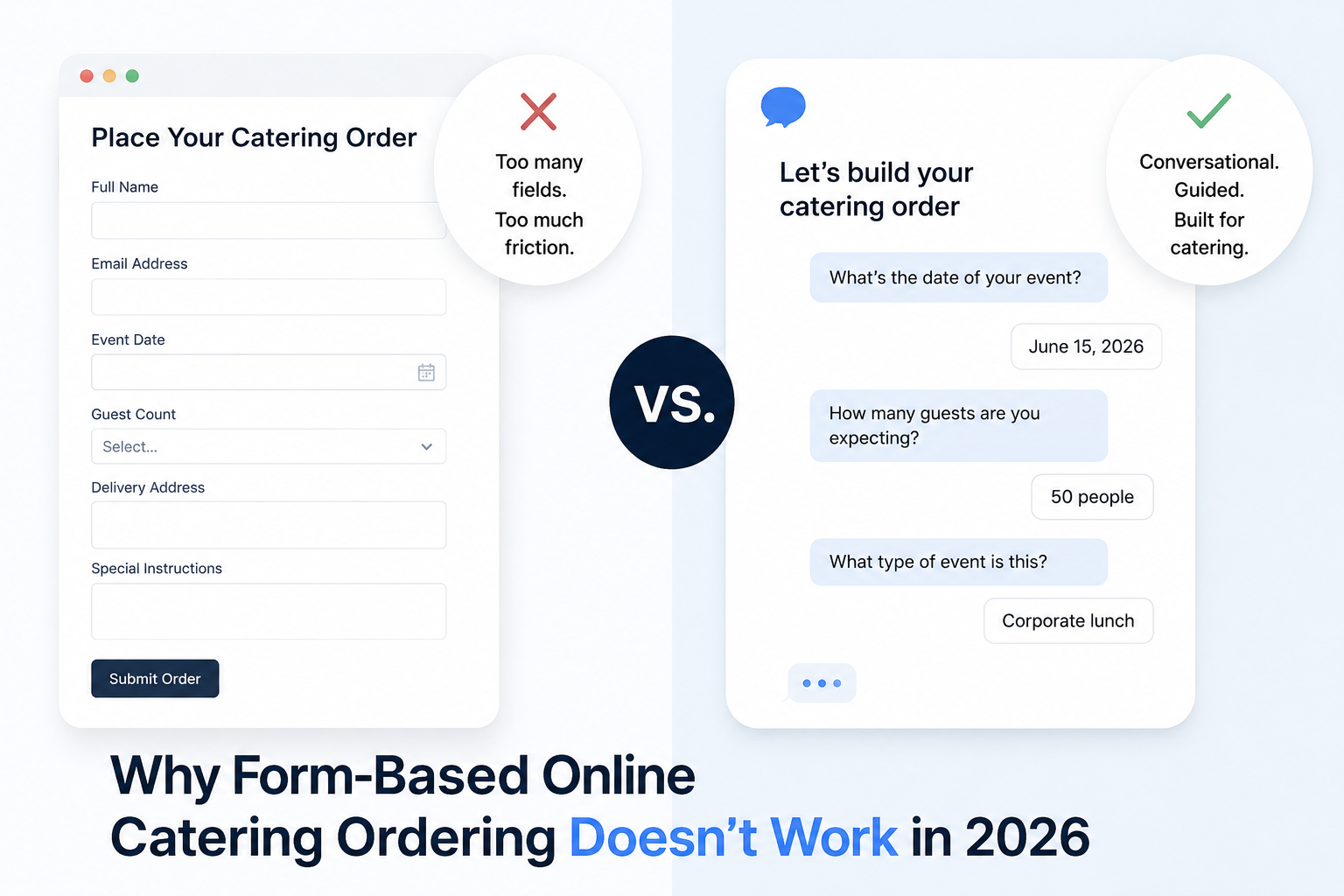
Online ordering forms work fine for a $15 burrito at lunch. They were not designed for a $400 corporate catering order with 12 dietary restrictions, a custom menu, a 3-week-out delivery date, and a buyer who wants to talk to someone before paying.
Most online catering ordering tools are exactly that: a slightly bigger form designed around a smaller order. The result is a high abandonment rate, a customer who calls anyway, and a sales team back in the loop. The form did not save the labor it was supposed to.
This post is not a sales pitch. It is an honest analysis of why classic forms break for catering and what the shape of catering ordering actually needs to look like.
Why was the classic form-based ordering designed?
The form pattern came from quick-service restaurants, where the order is simple: 1 item, 1 modifier set, 1 delivery address. Forms work great when the answer space is constrained.
Catering inherited the pattern because the tooling already existed. But catering orders have a much larger answer space:
- Multiple courses and sides, sometimes with substitutions
- Headcounts that change between booking and event
- Multiple delivery addresses for multi-location events
- Dietary restrictions that interact ("3 gluten-free, 2 vegan, 1 vegan AND gluten-free")
- Corporate buyers who want a custom menu, not the public menu
- Date ranges that include holidays, blackouts, prep windows
- Payment terms (PO numbers, NET 30, tax-exempt status)
A form forces all of this into discrete fields, dropdowns, and checkboxes. The form length explodes, the abandonment rate explodes, and the buyer calls anyway.
Where does it break for catering specifically?
Five predictable failure modes.
1. Dietary restriction interaction
Forms typically offer a checklist ("vegan," "gluten-free," "kosher," "halal"). They cannot represent "3 vegan, 2 gluten-free, 1 vegan AND gluten-free." The buyer either oversimplifies (leading to a botched order) or gives up and calls.
2. Custom menu requests
A form sells the menu the operator has built into the form. A corporate buyer who needs a custom menu (specific cuisine, specific dietary breakdown, specific budget) has no path in the form.
3. Date-and-availability complexity
Catering operations have prep windows, blackout dates, holiday schedules, and capacity constraints per day. A form date picker cannot represent any of this. The buyer picks a date, the form accepts it, and a human still has to confirm whether you can actually do it.
4. Quantity volatility
The buyer guesses 25 headcount at booking. By the event, the real number is 31. The form treats the original number as canonical. The 6 extra people show up hungry.
5. Buyer hesitation on big orders
A $400 catering order is a different commitment than a $15 burrito. Buyers hesitate. They want to talk to someone before paying. The form has no path for that, so the buyer abandons.
What do abandonment rates actually look like?
In catering specifically, public benchmarks and industry surveys put form abandonment at 60 to 80 percent for orders above $200. That number drops to 40 to 55 percent for simpler orders under $100. The harder the order, the more the form breaks.
Compare to consumer takeout ordering, where abandonment is closer to 15 to 25 percent. The form pattern works there. It does not transfer.
What does ordering need to look like to fit catering?
Three shifts.
1. Conversation, not form
A buyer should describe the event in their own words: "25 people, July 4th, beach barbecue, gluten-free for two, budget around $400." The system parses that, recommends matching packages, and converts the conversation into a structured order. The form becomes a result of the conversation, not the input.
2. Soft commitments before hard ones
The buyer should see realistic options and pricing before being asked to commit to a credit card. Hard payment commitment at the start of ordering is a major source of abandonment on big orders.
3. Escalation path to a human
For truly custom orders, the buyer should be able to hand the conversation to a human without losing all the context they already typed. The system passes the parsed event details to a sales rep, and the rep picks up where the buyer left off.
Is conversational ordering just a chatbot in a different shirt?
No, and this is the part that matters.
A chatbot is scripted: if the user says X, the bot replies Y. It cannot handle anything outside the script. The buyer notices in 30 seconds and abandons.
Conversational ordering powered by a real language model parses the buyer's actual sentence. It handles "can you swap the chicken for fish on 5 of those?" without anyone writing a rule for it. It writes the order summary in the customer's language. It escalates only the genuinely custom requests.
That is the structural difference. Forms cannot adapt. Chatbots cannot reason. Language-model-driven ordering does both.
How AIA does it
AIA Online Ordering runs on this exact pattern. The buyer describes the event in natural language, AIA matches packages, captures customer details automatically into the order summary, and confirms. A 35-second video on that page shows a real order from Pincho built this way.
Key takeaways
- Form-based catering ordering inherits a pattern designed for $15 burritos, not $400 corporate orders.
- Form abandonment on catering orders above $200 is 60 to 80 percent.
- Five reliable failure modes: dietary interactions, custom menus, complex dates, quantity volatility, and big-order hesitation.
- The fix is not a better form, it is a different shape: conversation in, structured order out, with an escalation path to a human.
- Chatbots are not the answer either. Real language-model parsing is the structural unlock.
If you want to see what catering ordering looks like when the form is replaced with a conversation, walk through AIA Online Ordering or request a demo.